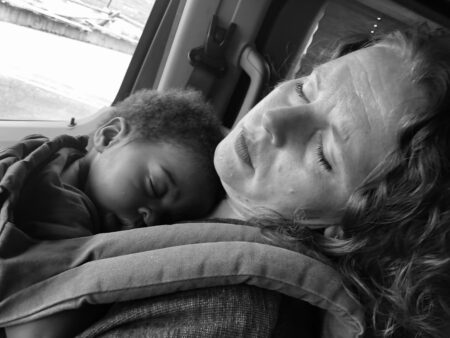
Siblings matter to children in foster care. They provide a source of stability and comfort when everything around them is changing. Whenever it’s safe and appropriate, brothers and sisters are supposed to be placed in homes together. For various reasons, that isn’t always possible. There may not be a home available that could keep all the siblings together. There may be a situation where one child needs a higher level of care or supervision. There can also be a history of abuse between siblings which means it isn’t safe for them to live together any longer. Siblings may have different noncustodial parents who are able to provide care for their own children, but not the siblings of their children. In Nebraska, our data indicates that in 2022 siblings were placed together over 60% of the time. That means there are still a lot of brothers and sisters who are growing up in different homes.
We’d like to help those kids experience normalcy and joy together so they can keep those sibling bonds intact.
We’ve created a Sibling Day Out program by partnering with donors to provide activities tailored to the interests of kids who are nominated and want to participate. We’re hopeful these will be positive connection points not just for the kids, but also for the families raising them. As foster and adoptive parents who have raised kids separated from their siblings, we know how important it is for the families to build relationships with each other. When you’re able to create a friendship or partnership with the family raising your foster or adopted child’s sibling, it’s much easier to help the children have natural relationships. We are excited to help kickstart those relationships for families who may not have had the opportunity or encouragement to make that happen.
But we need help! We’ve been able to pull together a lot of the logistics, but there are still ways to get involved. We currently have two large sibling groups we’re working with and we could use help getting their meals handled while they are participating in fun activities. We’ve got specific gift cards on our Amazon wishlist here or you can donate directly to our Cheddar Up fund, which will allow us to give you a tax deductible receipt. Just let us know you want the money to go to our Sibling Day Out program.
We’re excited to share with you how these events go as we’re able to get this program up and running! If you’re a Nebraska family that is interested in participating, contact your foster care agency, caseworker or CASA and they can get in touch with us for our nomination form for your family. And if you’re a Nebraska business that would like to partner with us to provide positive experiences for siblings in foster care, we’d love to be in contact!
November is Adoption Awareness Month and this year the word “awareness” is really sticking out to me. There have been seasons where I thought of it as “Adoption Positivity Month” and then years later it felt like “Adoption Shame and Guilt Month”. The different circles I’ve been in and the different voices I’ve listened to have influenced my perspective. But this year, I want to take seriously the idea of raising awareness about adoption. But what exactly do I want people to be “aware” of? I’ve got some thoughts after 20 years caring for other people’s children and 16 years as an adoptive parent.
-You should be aware that in your state right now there are kids in need of a family who can support them and provide them with stability. They have no legal parents and that is a terrible failure on so many levels. Their biological family should have gotten the help they needed to be able to parent if they could. Extended family and kinship options should have been pursued. The system should have been working a concurrent plan to make sure the kids were in a home willing to provide permanency while the parents worked their plan. Timeframes should have been established so kids didn’t wait so long in the system. But whatever the reason, there are kids who need a supportive family and you could be that family. (Here’s where you can find more information on waiting children.)
-You should be aware that adoptees don’t owe anyone their adoption story. I have kids who love to talk about their adoption and bring it up first thing when they are Star of the Week at school. I have kids who absolutely will not talk about it and will make it awkward if you ask. There’s a lot of curiosity about adoption, but this can be a very painful or intimate topic that doesn’t need to be explored unless the adoptee is the one bringing it up.
-You should be aware that adopted kids are just kids. They have an extra layer of trauma in their lives and brains because of the separation they experienced (no matter how old they were when they experienced it), but they are also wildly normal. They are on your kid’s basketball team and at their birthday parties and you have no idea. Adoptees are teaching Sunday School at your church, they’re your real estate agents or electricians. Adoption is so often portrayed in movies as something dramatic and it serves as the origin story for so many heroes or villains, it’s hard to realize just how beautifully boring it can be and how many lives it touches. If you find yourself in a conversation about adoption, you may be talking to a sibling of an adoptee, a birth parent, or an aunt of an adoptee without realizing it. Adoptees aren’t always interested in being the poster child for adoption and may not lead with that information.
-You should be aware that adoptive parenting is mostly the same as typical parenting. . . until it isn’t. All kids need meals and schedules and bedtime stories and help learning how to care for themselves and rides to soccer practice. We are adoptive families, but we are also just families and most of the time we think of adoption as a thing that happened one day to give us legal connection. But the part of our parenting that is about adoption. . . it can be brutal. The hardest conversations you can imagine where you realize how deeply this person you love more than anything has been hurt by choices you had nothing to do with. You can’t fix it. You can’t ignore it. You have to help them learn how to walk through it. And a lot of the difficult emotions are directed at you because you are safe enough to be angry at. Or there’s having to navigate life well as a family with multiple racial and ethnic identities. Or dealing with assumptions other people make about your adopted child and their story. Or maintaining healthy relationships with the biological family. Or advocating for your kids to get what they need. Or investing hours and hours in learning how to parent them in ways that are best for them, even if it’s different than what other parents are doing. If you don’t handle the adoption-centric part of your parenting well, it will have massive implications for the other parts of your parenting.
I have no regrets about adopting. Zero. Never for one minute of one day. I am so blessed to be parenting my children. I have such warm feelings about adoption because of what a gift it has been to me. My kids are doing phenomenally well and I know that isn’t a given. Our family is an adoption success story, but I know we aren’t the only story. It hurts to know there are kids just like mine who are still waiting for a family to call their own. It also hurts to know there are kids in adoptive families who aren’t getting their unique needs met or kids who are being pressured to share their deepest trauma in situations where it doesn’t feel safe, or kids who have to carry the weight of adult assumptions about what it means to be an adoptee. I’m hoping a greater level of awareness might be helpful to those kids and families like mine.
I was at a training about a month ago where a retired judge talked about the importance of creating a welcoming climate for kids who come to court. As part of his presentation he held up a board book and said he liked to give them to babies in his courtroom. He said, “Sometimes a mom would apologize that the baby chewed on the book and I would tell her that’s what they’re for and ask her if she wanted another one.” He encouraged the room full of child welfare professionals to think about what the experience of court is like for kids.
And I couldn’t think about anything else for the rest of the training.
I have been the one trying to keep a fussy baby quiet in court, making a bottle or holding out toys. I’ve been the one keeping preschoolers entertained with a new matchbox car I bought specifically for this occasion. I’ve been the one handing out lollipops– a new one as soon as the old one was finished because it’s hard to talk too much when your mouth is busy with a lollipop. I had one attorney tell me, “I don’t think I’ve ever seen your kids without a lollipop.” She wasn’t wrong. But I’ve juggled these things because it has been incredibly important to me to have the kids in court.
Over the years I’ve seen that not everybody brings their foster kids to court. Court can be scary for kids. It’s a place where there can be some formalities and a desire for calm. Sad truths may be shared. Transportation can be an issue for kids who would have to miss school and adults who have to take off work. Emotions may run high. Trauma can be triggered. Court is tough, beyond just keeping wiggly kids still. But I think kids need to be in court whenever it’s possible and appropriate.
Seeing that child helps remind everybody why we’re here. The team sees the children age as the case progresses. They have a chance to have their voice heard. It’s been one of the safest and most predictable places for us to make meaningful connections between the child, their biological family and the team. It’s a time for a child to have a moment with the lawyer representing their best interests.
So how do we make court a place where kids feel welcomed? A place where they know they matter. Maybe even a place they look forward to going? And how can we help facilitate a connection between them and their judge?
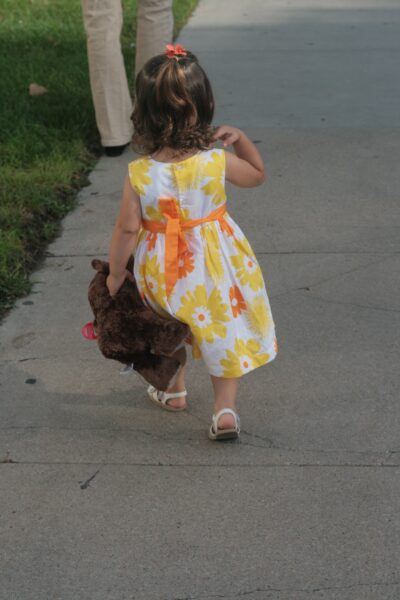
This well-loved bear was a gift from someone special in my daughter’s story. It was a present from her judge that she received at her adoption 12 years ago. Other stuffed animals have come and gone, but she can’t imagine getting rid of this bear. Not because it’s the cutest or nicest bear she’s ever had, but because her judge handed it to her. It matters because of who it came from.
This is a precious tradition each one of our adoptees has experienced, but it comes on a day that is already full of celebration and it’s the end of their relationship with their judge. What difference could it make to a case if every time a child came to court, they were able to feel personally welcomed, acknowledged, and had a special moment of connection with their judge? Could that make it easier for the child to open up? Would they feel the judge was really considering them as they make decisions? Would it be a natural moment for a judge to ask the child some questions?
This feels like a problem we can help solve. And I think we can do it with a little gift.
I am partnering with a local judge to pilot a project where we provide The Case for Toys for him to use in his courtroom. It will be a tote filled with objects intended to provide joy and a moment of connection for kids and youth of any age– from board books, to stuffed animals, to blankets, to journals and pens. We want the gifts to be quality, but the gifts aren’t really the point. They are a way to facilitate a connection. An interaction. A positive feeling.
I’m anticipating the start of this project could be a little bumpy as we figure out the best way to make it happen. That’s why we’re starting with one judge, one courtroom. We’ll run it for a couple months, meet to evaluate how it’s working, make necessary tweaks and then see if we can expand it. I’m looking forward to getting this judge’s input on the process as he helps us craft some best practices and guidance we can impart to other judges who want to implement it in the future.
I can’t tell you how excited I am about this. Genuinely giddy. And I’m thrilled that we’ve got a judge who is excited to start this too! As soon as we can get The Case in his hands, he’s ready to go. For so many years I have told people, “Not everybody can be a foster parent, but everybody can do something for foster kids.”. . . and then I struggled to help people find onramps to help. I am delighted to provide this onramp that will directly benefit court-involved kids, both by providing them something that brings joy, and by helping them develop a meaningful relationship with their judge.
If you want to help with this initial phase of figuring it out, I need you! I’m providing an amazon link here to what we’re hoping to use to start our initial Case. I’ve got pen sets and stuff animal sets and everything in-between, so there’s something for the price range of anyone who wants to help. My hope is to see what works best as the judge utilizes The Case and then create a standard list so we can make this scalable. How great would it be if these Cases could be sponsored and sent to courtrooms wherever they’re needed? I’m starting small, but I’m dreaming big.
If you want to help, here’s the amazon link and I will keep you updated as we move forward with the project.
If you would like to give directly to our organization (Connect 82:3) to cover administrative costs and give us some flexibility to buy things as needed, here’s the link.
(Connect 82:3 is a registered 501c3, but we are still in the waiting process for our IRS approval as a non profit, so we can’t issue tax deductible receipts at this time. You can find more info at the donation link posted above.)
Thank you for reading and caring and helping us with this project! I am ready to get this started and I can’t wait to tell you how it goes.
Moms who thrive on a routine and structure can start to feel this panic as the end of the school year arrives. WHAT ARE WE GOING TO DO EVERY DAY? I need the automatic scheduling the school system provides to tell me what to do and then I work around it. Freedom, creativity, endless hours of doing “whatever we want” (what I want to do is be on a schedule) is just not my jam.
Now I know that makes me one of those Not Fun moms and I’ll own that. I know who I am at this point. But I also think some of the Fun Moms end up banging their heads against the wall mid-summer when the kids are cranky and you’re losing your mind because it turns out WE ALL NEED ROUTINES. Even the fun moms. I want to emphasize that as someone who has devoted her life (personally and professionally) to caring for kids from trauma, routines are incredibly stabilizing if you have lived with any amount of instability in your world. Even kids who push against them likely benefit from them. Knowing what you can expect from your day (within reason– things can always change) allows your brain to focus on things other than stressing about what might happen.
Rebecca Tredway Photography
So I wanted to share with you a couple of the specific ways I make routine/schedule/rules happen that make my life easier. Some of these things won’t make sense if you just have a kid or two, but feel free to adapt or modify them in any way that works for your family.
-Posted Meal Schedule. I have a breakfast and lunch schedule that is pretty rigid during the summer. Mondays we have oatmeal for breakfast. Tuesdays we have eggs. You get the picture. I don’t have to think every day about what we’re going to be eating and I don’t stress out at the grocery store or during meal planning. I made the decision and I just follow the plan. Dinners are more flexible, depending on what food is in season/on sale, what evening plans we have, what we feel like eating, etc. But no matter what we’re eating, I write it down and post it on the fridge at the beginning of the week. This eliminates the need for me to answer the dreaded “what are we having for dinner” question.
-Screen Time Responsibilities. If my kids want to have screens, they have to complete a few simple responsibilities first. For us, that’s music practice, walk the dog, tidy their rooms, and do one “mom chore” that they pick from a basket of chores I’ve predetermined need to get done. Your list might be different, depending on what you’re working on with your kids. Maybe they need to do 30 minutes of reading or some creative project or go for a run. I’ve seen lots of fun ideas for how to make that work, but I needed a system that was pretty simple if I was going to follow-through. We have also reached a point with our older kids that I don’t have a required list before screens. My high schoolers are working jobs, spending time with friends, involved in church activities, doing summer conditioning for sports, etc. If they want to come home and play a reasonable amount of video games, I don’t care.
-Screen Hours. We’ve come up with a system that works for us to make sure screen time doesn’t get overwhelming, also allows the kids to have some control and allows me to utilize screens to help me when I need them. I give the kids (not including my high schoolers) an hour a day to use whenever they want, as long as they have done their Screen Time Responsibilities. They can use this hour or “bank” it until the next day (if they wanted to watch a long movie, they can just save up their hours). At the end of the week, any hours they didn’t use turn into dollars. We will reimburse them a dollar an hour, although I think the first year we did this our kids were young enough, we just did a quarter. You could also do a treat or whatever motivates your kids. So that hour is THEIRS, but there are also screen hours that are MINE. I can choose for them to use one if I need to make a phone call uninterrupted or run to the store and I want them occupied. They are likely getting 2 hours a day if they use their hour and I ask them to use an hour as a help to me. I won’t say this has solved the constant “can we be on screens” question, but it does allow them to have some additional control over that, so they aren’t arguing with me as much.
My son participated in a track meet in another city this winter. Track season is usually in the spring, but he conditioned all through the winter and participated in an indoor meet outside of what the public school typically offered. It was in a city about 45 minutes away and he said he’d just carpool with a friend. He told us it wasn’t a big deal, we didn’t need to come, he was just trying to stay in shape. After the meet, he showed me video of his race (he did great) and it felt like a gut punch. As I watched his tiny phone screen, I saw him running down the track and heard the unmistakable voice of a fellow parent yelling, “Go Josh!”
Such mixed feelings.
He wasn’t alone. Someone was cheering for him. He knew he had support in the stands. But it wasn’t me. It was another mom who loves him and has been at all his meets because her son is his constant competitor and close friend. She was able to be there in a moment when I couldn’t and could give him what I didn’t. I told my son how proud I was of him. I didn’t tell him how crushed I felt.
We all need a village. Especially those of us who are raising large families with a lot of different age ranges. It’s just not possible to be everywhere and do everything at once. Let me give you a window into the level of guilt I could be feeling today, if I wanted to just sink into a massive depression. My 2nd grader is on a field trip to the zoo that I couldn’t help chaperone. My third grader has her field day at the park that I’m also not attending. Two of my kids are out-of-town with my husband who has work obligations, so a family I love is watching them today and meeting all their needs during their first long trip away from home. My oldest son has a championship track meet I’m planning to attend, but that means I will be missing my middle school son’s track meet that’s happening at the exact same time across town. This is the same middle school son who had to skip his beloved jazz band practice before school today because I couldn’t figure out how to get him there with my sanity intact.
As I was expressing my frustrations with the logistics of today, two friends of mine just solved some of my track meet transportation problems. They offered support and rides and meals and childcare and this smooth coordination of all the details that freed me up to do what I could do for my kids. They are amazing humans and I wish I didn’t need them the way I do.
We have been involved in church small groups for years. I remember babysitting for other people’s small groups during my teen years and hiding in the basement while my parents were hosting their own. I believe strongly that creating community happens best in homes around cups of coffee or a shared meal. Sunday mornings with your church are beautiful and have an important purpose to serve, but if you want to get in deep with people, you have to find additional connection points and set aside time to be together.
When we joined our new church about a year ago, we struggled to get connected. We left a church where we had deep connections built over years and we keenly felt their absence. We are joiners. We want to be at the church whenever the doors are open and we want to know who we’re worshipping next to. We aren’t trying to check off a box of church attendance, but find a space where we can function as part of a Body. I’m saying we “struggled” but the reality is that it took an appropriate amount of time for us to figure out where we fit within a bigger church community. We wanted to use our gifts and it turns out part of our gifting is being vulnerable enough to reach out for community when we don’t immediately find it.
Rebecca Tredway Photography
So this last Fall I put out some feelers with people we thought might want to be part of a small group with us. We’ve been a part of different kind of models– intentionally age and stage diverse, groups where we were the oldest and it was mostly young couples, and a group where it was all young adults in their early 20s (adult youth group. . . those were the days). I’ve seen benefits to each type and in my ideal world I think it’s important to have different viewpoints and experiences represented. But at the stage we’re currently in (8 kids, 3 different schools), it felt really important to create extra connections with the families we’re most likely to do life with– our neighbors. My understanding of Catholic churches is that they function on a parish model– you go to church near where you live and your kids might attend a school at that church. This creates a lot of extra connections between families (we live near a Catholic church and see the fruit) and I wanted a chance to see how that would work for us. And the short story is that it’s been a great fit.
But I could sense some hesitancy when we started.
We are joiners, but that’s not everybody’s thing. I think we live in a time where people are really reticent to make plans or commitments, especially because of how busy we tend to be. If you aren’t used to prioritizing a small group meeting during the week, that can feel like a lot to add on top of work, youth sports, hobbies, the gym, extended family commitments, homework, time with friends, etc. So when I suggested we meet weekly, it was met with some skepticism. Understandably. I was offering to host a dessert for the adults once a month and a dinner for all the families once a month (roughly 16 adults and plenty of kids). I was hoping someone would host a women’s get together and someone else could host a men’s get together. This way we would meet weekly throughout the month. That was too much. People were willing to come if I hosted two nights a month, but they didn’t want to meet more frequently than that. So that’s what we did.
And I just want to tell you that this has felt like that story “Stone Soup”. Do you know what I’m talking about? These soldiers come through the town and want some hospitality and nobody has the resources, but then they offer to bring some stones for stone soup and everybody ends up bringing something to share to make the soup delicious. I’m out here offering stones and this group has made it work so much better than I imagined.
I thought I’d be hosting twice a month. I think that happened one time. After that, everybody just took turns offering to host and provide dessert or the main dish when it worked for them, and we’ve found that when there’s a large enough group of us for meals, it works better to have it at the church. Somebody else planned the potluck dinners. Someone sent the text thread reminders and clean-up is always a group effort. We leave feeling refreshed and one of my favorite things is that our kids are building community with their peers that they both go to church and school with. It’s worked beautifully. And I have hopes for more next year as we continue to develop these friendships.
But it does have to start somewhere. Somebody has to risk offering their meager stones.
I genuinely love being physically affectionate with my kids. . . until I don’t. I have eight kids and my oldest is 16. That’s a lot of years of dealing with kids when they are at their physically neediest and there are times I’m just a little bit tired of being touched. It’s hard to explain to someone who hasn’t parented a toddler just how constant the touching is. I can’t remember what it’s like to brush my teeth without someone dropping the bathroom stool on my toe so they can brush RIGHT. NEXT. TO. ME. Cooking dinner is an obstacle course of stepping over and around the little person who is pretend cooking with me/next to me/on me/behind me. I can’t tell you how many times I’ve eaten a meal with a small person on my lap and I’ve dropped spaghetti into toddler hair more times than I can count. This is draining on a level it’s difficult to define. I live in a world where there is no such thing as “personal space” and I’ve lived there for the last 15 years or so. (full disclosure– I’m typing this with a toddler on my lap)
I can’t change the reality of parenting a toddler. They need my physical presence. They need comfort and someone to meet their needs. I am their primary caregiver and they aren’t doing anything wrong by being needy. So I have to figure out a way to keep my sanity intact when my body is screaming for me to go lock myself in the bathroom (which I still do on occasion).
I’ve come to realize that some of the issue for me is my own self-talk. My inner monologue is about how this will never end, I just need some space and something about the unfairness of motherhood (“I bet my husband is sitting in a whole office chair BY HIMSELF right now.”). So I’ve had to intentionally go a different route to help me stay more present with my kids and diffuse some of my own frustration. There are two specific times when I’ve found a little messaging goes a long way.
When my kids are hurt (visualize me putting air quotes around the word hurt and saying it with a little sarcasm), I sometimes struggle to give them the comfort they need. And this is your reminder that toddlers get “hurt” about 5,732 times per day. The injuries are often invisible, which doesn’t make them any less dramatic. And I currently have two toddlers. So when there is an injury only Mom can fix (but Mom would really like to JUST FINISH HER MEAL IN PEACE ONE TIME IS THAT TOO MUCH TO ASK EVERYBODY), I will get down on the floor and stroke their little backs while I tell myself, “Rat nurturing behaviors. Rat nurturing behaviors.” Totally normal, right? We’re all doing this? No? Let me explain.
I read a study forever ago about how rat personalities were impacted by how the rat mothers treated them. Rat mothers that engaged in nurturing behaviors like licking them, patting them, grooming them, nursing them had more calm rat kids. Rat mothers that ignored their babies had babies that were more anxious even into adulthood. (I’ve written about this before) I don’t know why that study impacted me so much, but it fundamentally changed the way I parented, or at least my self-talk around parenting. I want my kids to be calm. I don’t want them to struggle with anxiety. I need to be calm with them and I need to do physical nurturing behaviors.
The rat mothers aren’t having long talks with their babies. They aren’t saying the specific right words that teach them resiliency. Sometimes I just don’t have it in me to do those things either, as important as I think they are. Sometimes all I have in me during a very touched-out day is to remind myself to be a nurturing mother rat. I can pat. I can hug. I can kiss. I can take a minute to stop and physically reassure this child because it’s not just about what’s happening in the moment, it’s about helping them to grow up feeling the assurance that they are loved and nurtured.
I read a headline recently that I originally thought was a joke: Marie Kondo admits she has “kind of given up” on tidying up after having three kids. Hilarious. But there’s no way that could be real. As a casual observer of your work, I was confused. But as a mom, there was zero confusion.
Motherhood is messy. Literally. Figuratively. All of it.
I remember first hearing about your philosophy of getting rid of items that don’t “spark joy.” I looked around my house and gleefully imagined purging all the brightly colored, noisy, plastic toys that clutter my space each and every day. They bring me no joy. But I don’t live here by myself.
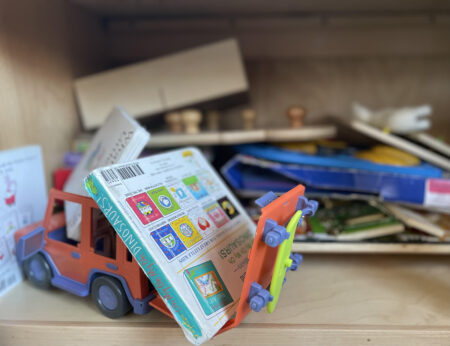
My kids exist in this space too, and their joy also matters. The worn stuffed animals, the dog-earned graphic novels, the gaudy Little People school bus (and barn and airplane and house), and the innumerable Marvel action figures– they all spark joy for someone I love, even if it isn’t me. My house looks like people live here. Because we do.
My son snapped this picture of me a few summers ago. When I look at it, I am immediately transported back to a moment in time. And that moment was not pleasant.
We were on vacation in Colorado. Vacations with kids are not my happy place as much as I truly wish they were. This particular day was a doozy. We had driven a curvy road in our massive van up the top of a peak. I was NERVOUS the entire time, which meant doing irrational things, like leaning my body into the opposite direction of every curve in the hopes of keeping us from toppling down the mountain. The kids were oblivious to my sheer terror and kept asking for me to do normal mom stuff, like open their snacks and tell them which Marvel superhero I thought could jump highest.
When we got to the top, the air felt so thin to these Midwestern lungs. I felt sick and I had a crabby baby strapped to my chest who wasn’t feeling so great herself. She was fine letting everybody know how unhappy she was and I was embarrassed because sound really travels at the top of the world.
My family has a yearly tradition of reading a chapter a day of the book of Luke, leading up to Christmas. It has been such an enriching experience that helps center our holiday season on what is most important to us. If you’d like to join us in these readings, I’m providing questions to talk through with your kids to help spark conversations and meaningful engagement with what you read. I hope it’s helpful!